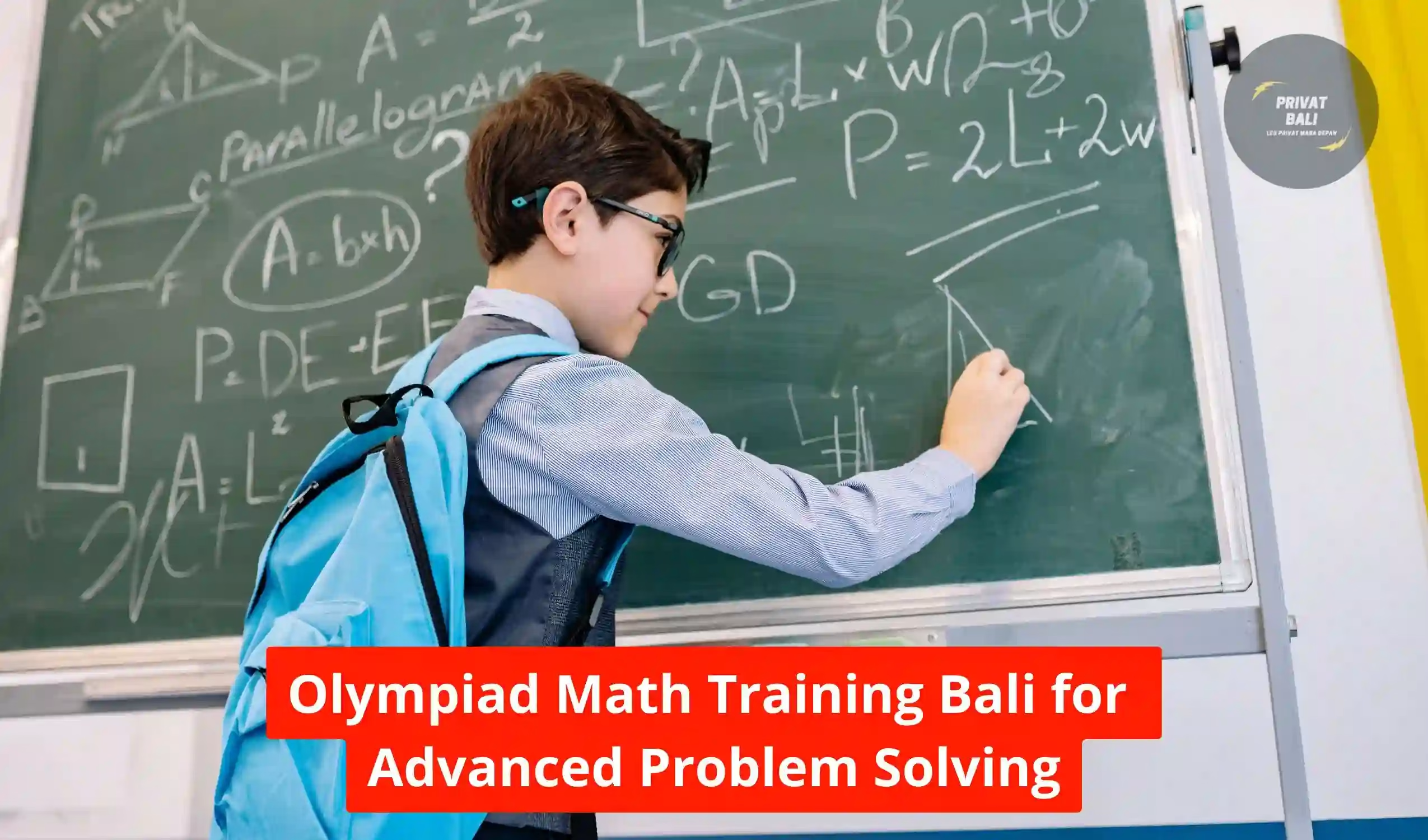
Olympiad Math Training Bali helps ambitious students develop advanced problem solving, mathematical reasoning, creative thinking, proof skills, and competition confidence through personalised mathematics coaching.
Olympiad Math Training Bali is designed for students who want to go beyond ordinary classroom mathematics and explore more challenging mathematical problems.
Instead of focusing mainly on routine exercises, Olympiad training develops the ability to recognise patterns, build strategies, test ideas, construct logical arguments and solve unfamiliar problems.
Mathematics competitions often present questions that do not reveal the method immediately. Students may know many formulas and still need to think carefully before deciding where to begin.
That difference makes Olympiad mathematics a distinct learning experience.
A strong training programme gives students time to explore difficult questions, make mistakes, reconsider their approach and eventually discover a solution. Over time, this process can strengthen mathematical maturity and create a more flexible approach to problem solving.
The International Mathematical Olympiad provides a clear example of this level of challenge. The official IMO problem archive includes questions involving algebra, geometry, number theory, combinatorics, inequalities, functional equations and other areas of advanced mathematical reasoning.
For students in Bali, private Olympiad mathematics coaching can provide a focused environment where these skills develop progressively.
What Olympiad Math Training Actually Develops
Olympiad mathematics is not simply advanced school mathematics.
A school exercise often tells students which topic they need to use. An Olympiad problem may provide no such indication.
The student must identify the structure first.
A question may appear to involve geometry but actually depend on an inequality. Another may look like a number theory problem while requiring an unusual observation about parity or divisibility.
Therefore, Olympiad training develops strategic thinking.
Students learn to ask better questions.
What information does the problem provide?
What patterns appear?
What happens in a small example?
Can the problem become simpler?
Is there a hidden symmetry?
Can the statement be rewritten in another form?
These habits gradually become part of the student’s mathematical thinking.
The official IMO problem sets demonstrate this style clearly. Recent problems include proof based questions involving integers, geometry, functions, games, sequences and combinatorial structures.
Why Olympiad Mathematics Feels Different From School Mathematics
Ordinary classroom mathematics often builds skills through structured progression.
Students learn a concept, study an example and then practise similar questions.
Olympiad mathematics changes the balance.
Students still need strong fundamentals, but they also need to discover methods independently.
A difficult competition problem may take considerably longer than a normal classroom exercise.
The student may try one approach, discover that it fails, test another idea and eventually find a useful pattern.
That process is not wasted time.
It forms part of mathematical learning.
The student learns how to remain curious when the answer does not appear immediately.
This mindset can become valuable across many areas of academic study.
Building Strong Mathematical Foundations Before Olympiad Training
Advanced problem solving requires strong fundamentals.
Students need confidence with arithmetic, algebra, geometry, fractions, equations, functions and logical reasoning before they can consistently handle more sophisticated competition problems.
However, strong foundations do not mean memorising hundreds of formulas.
Students need to understand how mathematical ideas connect.
For example, a student studying divisibility should understand how factors, multiples, prime numbers and remainders relate to one another.
A student studying geometry should recognise relationships between angles, triangles, circles and transformations.
A student studying algebra should become comfortable manipulating expressions while also understanding what those expressions represent.
This is why Olympiad training often begins with assessment rather than immediately presenting the hardest available problems.
The tutor first identifies what the student already understands.
Then the training can build from that foundation.
Families looking for broader mathematics support in Bali can also explore Tutor Matematika Bali for related private mathematics learning options.
Olympiad Algebra And Creative Mathematical Thinking
Algebra plays an important role in competition mathematics.
However, Olympiad algebra often differs from routine equation solving.
Students may need to identify hidden relationships, transform an expression, construct an inequality or analyse a functional relationship.
The main challenge often lies in discovering the right transformation.
For example, a problem may present several variables with unusual conditions.
Instead of immediately calculating individual values, a student may need to identify an invariant or discover a relationship between the variables.
That requires flexible thinking.
Olympiad training can introduce students to techniques such as substitution, factorisation, symmetry, inequalities and functional reasoning.
The objective is not to memorise tricks.
Students should understand why a technique works and recognise when it might become useful.
This creates transferable mathematical skills.
Number Theory Training For Mathematical Competitions
Number theory is one of the areas that frequently appears in advanced mathematics competitions.
Students may encounter questions involving prime numbers, divisibility, remainders, greatest common divisors, least common multiples and integer sequences.
These topics can look simple at first.
Yet they can produce surprisingly deep problems.
A short question about positive integers may require a carefully structured proof.
The student may need to examine parity, construct a contradiction or identify a pattern among several cases.
The official IMO archive provides many examples of this style. Recent problems include questions involving positive integers, divisors, sequences, greatest common divisors and functional relationships.
Private coaching gives students the opportunity to study these ideas slowly and understand the reasoning behind each solution.
Geometry Olympiad Training In Bali
Competition geometry requires students to see relationships that may not appear immediately.
A diagram can contain several useful structures at once.
Students may need to recognise equal angles, similar triangles, cyclic quadrilaterals, perpendicular relationships or hidden symmetry.
Sometimes the key insight comes from drawing one additional line.
Sometimes the solution depends on transforming the diagram.
At other times, algebra provides the most effective route.
Olympiad geometry therefore develops visual reasoning as well as logical thinking.
Training should expose students to different ways of viewing the same figure.
A tutor can ask students to explain why a particular construction helps rather than simply showing the completed solution.
That distinction matters.
The student should gradually learn to create useful constructions independently.
Combinatorics And Logical Problem Solving
Combinatorics introduces another style of mathematical thinking.
Students may need to count arrangements, analyse cases, construct patterns or prove that a particular configuration must exist.
These problems often reward creativity.
A direct calculation may become complicated, while a clever observation can simplify the entire problem.
Students therefore need to learn how to organise information.
They might create a systematic table, identify symmetry, divide the problem into cases or look for an invariant.
The process teaches students to manage complexity.
That skill can support mathematics well beyond competitions.
Proof Writing And Mathematical Communication
One of the biggest differences between advanced competition mathematics and ordinary classroom work involves proof.
Finding an answer does not always complete the task.
Students may need to demonstrate why the answer must be correct.
That requires logical structure.
A strong proof explains the assumptions, develops the argument and reaches a conclusion without unexplained jumps.
Students therefore need to learn mathematical communication.
They should understand the difference between checking several examples and proving a statement for every possible case.
This distinction becomes particularly important at higher competition levels.
The official IMO format includes proof based problems, and the published problem sets clearly use commands such as prove, determine and show.
Olympiad training can introduce proof gradually.
Younger students can begin by explaining why an observation works.
Older students can progress toward formal arguments involving contradiction, induction, invariants and other proof strategies.
Problem Solving Strategies For Olympiad Students
Good competition training should teach students how to begin.
Many students freeze when they encounter an unfamiliar problem because they expect an immediate formula.
Olympiad mathematics rarely works that way.
Instead, students can develop a collection of questions that guide their first steps.
Can I test a small case?
Can I draw the situation?
Can I rewrite the condition?
Can I look for symmetry?
Can I work backwards?
Can I simplify the problem?
Can I identify what must remain unchanged?
These questions do not guarantee a solution.
However, they create productive starting points.
The student learns to investigate rather than guess.
Over time, difficult problems become less intimidating because the student has a process for exploring them.
Training Students To Learn From Difficult Problems
A difficult problem does not need to produce an immediate correct answer to become useful.
In fact, struggling with a problem can provide valuable mathematical experience.
The student learns what happens when a particular strategy fails.
They may discover an assumption that does not hold.
They may find a useful pattern while testing examples.
They may also learn that a promising idea needs a different interpretation.
A good tutor can use these moments as part of the lesson.
Instead of revealing the solution too quickly, the tutor can provide a small hint.
The student then continues independently.
This approach keeps the intellectual work with the learner.
It also develops persistence.
Personalised Olympiad Math Training Bali
Students enter Olympiad training at very different levels.
One student may already enjoy solving challenging problems but lack formal proof skills.
Another may have excellent school grades but little experience with unfamiliar questions.
A third student may have strong mathematical intuition but need more systematic methods.
Personalised coaching can respond to these differences.
The tutor can select problems that stretch the student without creating unnecessary frustration.
The difficulty can increase gradually as the student’s skills develop.
This approach also allows training to remain connected to school mathematics.
A student preparing for Cambridge Mathematics, for example, may strengthen core mathematical reasoning while exploring competition problems.
Cambridge Lower Secondary Mathematics itself emphasises principles, patterns, systems, functions and relationships, alongside a feature called thinking and working mathematically.
For broader private mathematics support, families can explore Les Privat Matematika Bali.
Olympiad Preparation For Cambridge Students
International school students can combine curriculum learning with competition preparation.
Cambridge Mathematics develops mathematical understanding, reasoning and problem solving. Cambridge Lower Secondary encourages students to make connections between mathematical facts, procedures and concepts while providing evidence for their conclusions.
Cambridge O Level Mathematics also emphasises patterns, relationships, analytical reasoning and mathematical problem solving.
These skills can provide useful foundations for competition mathematics.
However, Olympiad preparation goes beyond the standard curriculum.
Students need additional exposure to unfamiliar problems and proof based reasoning.
For students following Cambridge IGCSE or international programmes, this can create an interesting academic extension.
Students who already enjoy mathematics can explore deeper problems without changing their main school programme.
For more Cambridge focused mathematics support, see Cambridge Math Expert Bali.
Training For Students Who Enjoy Mathematics
Not every Olympiad student needs to begin with the goal of winning a competition.
Some students simply enjoy difficult mathematics.
They like puzzles, patterns and questions that require several attempts.
For these students, Olympiad training can provide intellectual challenge.
The lessons can introduce mathematical ideas that students may not encounter deeply in ordinary classroom work.
This can also help students discover which areas of mathematics interest them most.
One student may enjoy geometry.
Another may prefer number theory.
Someone else may become fascinated by combinatorics or functional equations.
That exploration can help students develop a more personal relationship with mathematics.
Olympiad Training For High Achieving Students
High academic performance does not automatically translate into competition performance.
A student may achieve excellent school grades by mastering the curriculum thoroughly.
Olympiad problems require another layer of flexibility.
Students need to deal with unfamiliar structures and often incomplete information about the intended method.
Therefore, advanced students can benefit from deliberately practising problems that do not resemble their usual homework.
The tutor can also introduce increasingly complex problems as the student becomes comfortable with the process.
This creates a training environment where mistakes become useful feedback rather than simply incorrect answers.
From School Mathematics To Competition Mathematics
The transition into Olympiad mathematics should feel progressive.
Students first need strong fundamentals.
Then they can explore non routine problems.
After that, they can develop specific strategies.
Finally, they can work on full competition style sets under realistic conditions.
This progression helps students understand the difference between knowing mathematics and using mathematics creatively.
A student might already know the Pythagorean theorem.
Olympiad training asks what happens when the theorem appears indirectly within a more complicated configuration.
A student might understand prime numbers.
Competition mathematics asks what can be deduced from a surprising condition involving divisibility.
The underlying mathematics may remain familiar.
The thinking process becomes more demanding.
Timed Olympiad Practice And Competition Readiness
Timing becomes relevant as students move closer to an actual competition.
However, early training should not focus entirely on speed.
Students first need to learn how to think deeply.
Once they develop stronger strategies, timed practice can help them manage pressure and allocate their attention.
A tutor can introduce selected problem sets and review the student’s approach afterwards.
The review matters as much as the timed session.
Students should understand which problems consumed too much time and which approaches created unnecessary complexity.
They can then adjust their strategy for future practice.
The official IMO is held over two contest days, with each day involving a demanding set of mathematical problems. The 2026 edition took place in Shanghai in July and involved 666 contestants from 117 countries.
That scale illustrates why serious competition preparation involves more than ordinary classroom practice.
Olympiad Mathematics And Future Academic Development
Competition mathematics can complement broader academic development.
Students who enjoy mathematical problem solving may later explore mathematics, computer science, engineering, physics, economics or other quantitative disciplines.
Olympiad training does not guarantee success in any particular university pathway.
Instead, it develops habits that can support demanding academic work.
Students learn to analyse unfamiliar information.
They learn to persist through difficult problems.
They learn to communicate logical arguments.
They learn to question assumptions.
They also learn to test whether their reasoning actually supports their conclusion.
These habits can remain useful long after a competition ends.
Students planning overseas university pathways can also explore University Admissions Bali for broader academic planning support.
Choosing An Olympiad Mathematics Tutor
Parents should look beyond ordinary mathematics teaching experience when choosing competition coaching.
Olympiad training requires familiarity with non routine problems.
The tutor should understand how to guide a student without immediately revealing the solution.
Communication also matters.
A strong explanation should make a difficult idea clearer rather than make it appear mysterious.
It also helps when the tutor can adjust the difficulty.
A student who has just started competition mathematics needs a different programme from a student already comfortable with proof based problems.
The training should therefore begin with the student’s actual level.
What A Typical Olympiad Coaching Session Can Include
A productive session may begin with a short review of an earlier concept.
The tutor can then introduce a carefully selected problem.
The student receives time to explore possible approaches.
If necessary, the tutor provides a small hint rather than the complete solution.
After the student reaches a conclusion, the tutor reviews the reasoning.
The final discussion can compare alternative approaches.
This structure keeps the student actively involved.
It also creates opportunities to discuss why one strategy works more efficiently than another.
Over time, students develop a personal collection of mathematical ideas and strategies.
Frequently Asked Questions About Olympiad Math Training Bali
What is Olympiad Math Training Bali
Olympiad Math Training Bali is specialised mathematics coaching for students who want to develop advanced problem solving, logical reasoning, mathematical creativity and competition skills.
Is Olympiad mathematics suitable for younger students
Yes. Younger students can begin with mathematical puzzles, patterns, logic problems and accessible non routine questions before progressing toward more advanced competition mathematics.
Does Olympiad training require advanced mathematics
Not always. Strong fundamentals are important, but students can begin competition training at different levels. The tutor can adjust the complexity of the problems according to the student’s current skills.
What topics appear in mathematics Olympiads
Common areas include algebra, geometry, number theory and combinatorics. Recent official IMO problems also demonstrate the use of functional relationships, sequences, inequalities and game based mathematical structures.
Does Olympiad training involve proof
Yes. Many advanced competition problems require students to prove a statement rather than simply provide a numerical answer. Official IMO problem sets regularly include proof based questions.
Can Cambridge students join Olympiad mathematics training
Yes. Competition training can complement Cambridge Mathematics by giving students additional opportunities to explore unfamiliar problems and deeper mathematical reasoning.
Can Olympiad coaching help students who already perform well at school
Yes. Students who already achieve strong school results can use competition training to develop more flexible problem solving and work with questions that go beyond routine curriculum exercises.
Is Olympiad training only about winning medals
No. Competition preparation can also develop persistence, reasoning, creativity, proof writing and independent mathematical thinking.
How early should a student begin Olympiad preparation
There is no single starting age that suits every student. Earlier exposure can help students become comfortable with non routine problems, while older students can begin with more advanced competition material.
Can private Olympiad training take place online
Online tutoring can work well for mathematics when the tutor and student use a suitable digital writing environment. The exact format can depend on the student’s needs and tutor availability.
Start Developing Deeper Mathematical Thinking
Olympiad mathematics asks students to look beyond the obvious method.
It encourages them to search for patterns, test ideas, build connections and explain why a solution works.
That process can feel challenging at first.
However, with appropriate guidance, students can gradually become more comfortable with uncertainty and unfamiliar problems.
Olympiad Math Training Bali provides an opportunity to make that process more structured and purposeful.
Students can strengthen algebra, geometry, number theory and combinatorics while developing the reasoning skills needed for demanding mathematical problems.
For students who already enjoy mathematics, the experience can also open the door to a deeper and more creative side of the subject.
If your child is ready to explore challenging mathematics with personalised guidance, explore private tutoring through Privat Bali.
A focused programme can begin from the student’s current level and develop toward more sophisticated mathematical problem solving at a pace that makes sense for them.