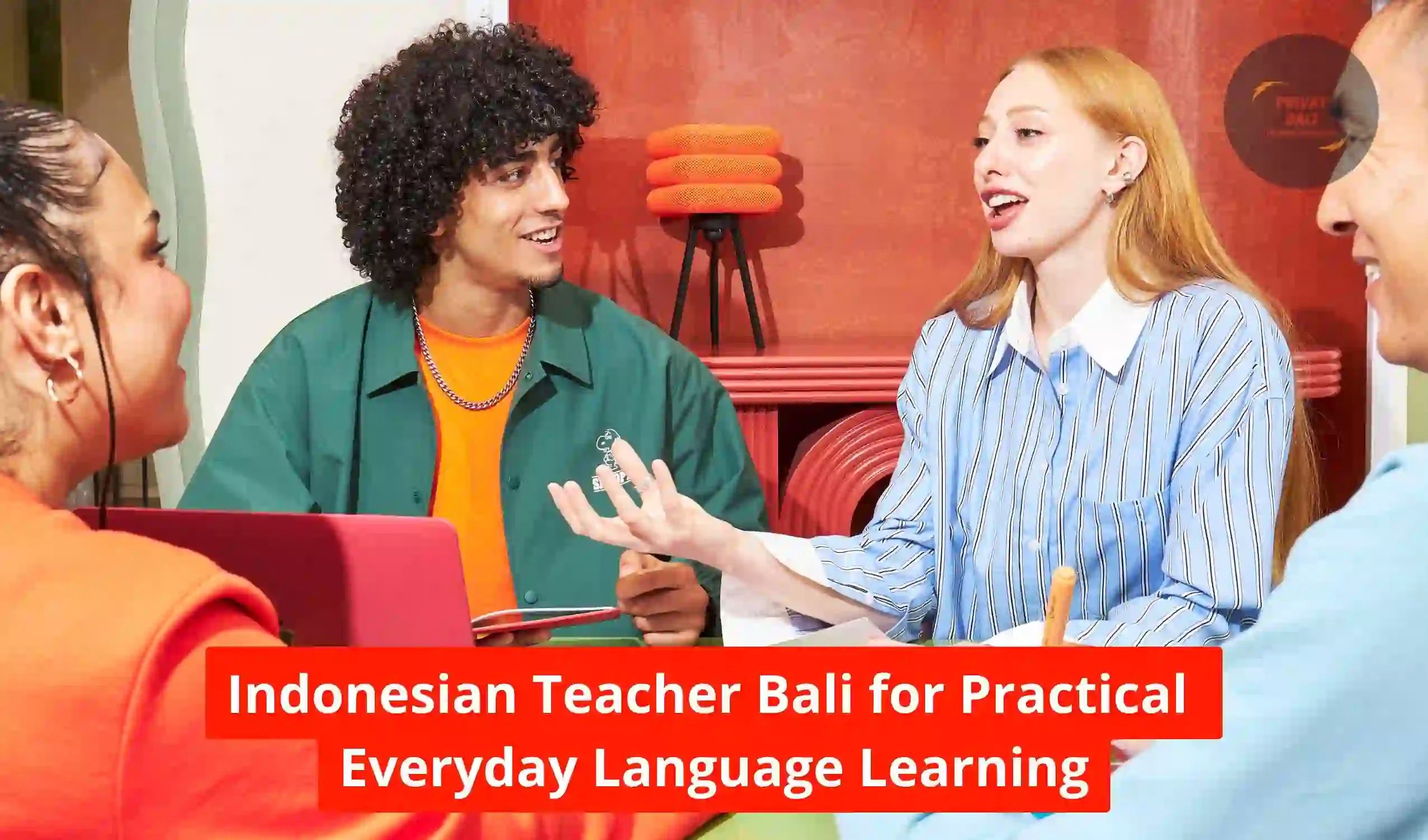
Learn Bahasa Indonesia naturally with an Indonesian teacher Bali for conversation, daily communication, cultural understanding, family life, travel, and personalised private lessons.
Living in Bali becomes more meaningful when you can communicate with the people around you.
An Indonesian teacher Bali can help international residents, visitors, families, students, and professionals develop practical Bahasa Indonesia for everyday situations.
Rather than learning vocabulary only from textbooks, learners can practise expressions they actually use.
That may include speaking with neighbours, ordering food, asking for directions, communicating with staff, talking with drivers, or making simple conversations in local communities.
Private Indonesian lessons also give learners more freedom to study at a comfortable pace.
The teacher can adjust the vocabulary, conversation topics, pronunciation practice, and lesson activities according to the learner’s background.
As a result, Bahasa Indonesia can become part of daily life rather than another subject to study.
Why Learn Bahasa Indonesia With a Teacher in Bali
Living in Bali creates countless opportunities to hear Bahasa Indonesia.
You may hear it at a restaurant, market, school, hotel, workplace, neighbourhood, or during a conversation with a local resident.
However, hearing a language does not automatically make communication easy.
Many learners understand individual words but struggle to create natural sentences.
Others know basic phrases but hesitate when someone responds quickly.
A private Indonesian teacher can bridge that gap through guided conversation and practical correction.
Instead of memorising long vocabulary lists, learners can practise language that matches their real environment.
This approach can make lessons more relevant and easier to remember.
It also gives learners the confidence to use Indonesian outside the classroom.
Practical Bahasa Indonesia Lessons for Everyday Communication
Everyday communication forms an important part of learning Indonesian in Bali.
A learner may want to know how to greet someone appropriately.
Another learner may need vocabulary for shopping, transportation, accommodation, or dining.
Parents may want to communicate more naturally with school staff and people who support their family.
Meanwhile, professionals may need Indonesian for meetings, colleagues, suppliers, or local business relationships.
A private teacher can build lessons around these situations.
The teacher can introduce useful expressions and then practise them through realistic conversations.
This method helps learners understand not only what to say, but also when and how to say it.
Indonesian Conversation Practice for Foreign Residents
Conversation often represents the biggest challenge for adult language learners.
A learner may understand a sentence when reading it but become uncertain during a live conversation.
Private conversation practice creates space to work through that difficulty.
The teacher can speak at an appropriate pace and gradually introduce more natural expressions.
The learner can then respond, ask questions, and repeat difficult phrases.
Over time, these conversations can become more spontaneous.
This progress matters because real conversations rarely follow textbook dialogues exactly.
People shorten expressions, use familiar vocabulary, and change their wording depending on the situation.
A good Indonesian teacher can introduce these variations gradually.
Indonesian Language Learning Through Real Bali Situations
Bali provides an interesting environment for practical language learning.
A lesson can begin with a simple topic and then connect it to situations the learner encounters during the week.
For example, a learner who frequently visits traditional markets can study food vocabulary and bargaining expressions.
Someone who works with local staff may practise workplace conversations.
A parent may focus on school communication and everyday family interactions.
A traveller may concentrate on transportation, directions, restaurants, and social conversation.
Because the learning context comes from real life, the vocabulary often feels more useful.
The learner also has an immediate opportunity to practise outside the lesson.
Understanding Indonesian Pronunciation and Natural Expressions
Pronunciation plays an important role in effective communication.
Indonesian pronunciation can appear relatively approachable to beginners, yet learners still need practice with rhythm, sounds, word stress, and natural sentence flow.
A teacher can listen carefully and correct pronunciation during conversation.
This immediate feedback can prevent small mistakes from becoming permanent habits.
Natural expressions also matter.
A sentence may be grammatically understandable but still sound unusual in everyday conversation.
A local Indonesian teacher can explain more natural alternatives and show how people commonly communicate.
This distinction helps learners move beyond basic textbook Indonesian.
Indonesian Teacher Bali for Expatriate Families
Families living in Bali may have several different language needs.
Parents may want to communicate more comfortably with local communities.
Children may need Indonesian for school or social interaction.
Other family members may simply want enough vocabulary to handle everyday activities independently.
Private lessons can accommodate these different goals.
The teacher can work with each learner according to age, ability, and purpose.
Younger learners may benefit from games, stories, pictures, and practical conversation.
Adults may prefer direct speaking practice connected to work, family life, travel, and social situations.
This flexibility makes private tutoring suitable for families with different learning preferences.
Families who need broader academic support can also explore Tutor for Expat Kids Bali as part of their children’s education planning.
Indonesian Lessons for Children Growing Up in Bali
Children who spend significant time in Bali can benefit from learning Indonesian naturally.
They may already hear Bahasa Indonesia around them every day.
However, regular exposure does not always create strong speaking skills.
A structured private lesson can give children the opportunity to practise vocabulary and sentence patterns more deliberately.
Lessons can also connect Indonesian with topics children enjoy.
Animals, food, sports, school, hobbies, friends, travel, and stories can all become useful conversation themes.
The teacher can gradually introduce more complex vocabulary as the child becomes comfortable.
This approach keeps language learning engaging without making every lesson feel like a formal classroom.
Indonesian Teacher for International School Students
International school students often move between different languages during the day.
They may use English at school and another language at home.
Indonesian can then become an additional language used in the wider community.
Private tutoring can help students build confidence in this third language environment.
Lessons can focus on speaking, reading, vocabulary, pronunciation, or practical communication.
For students who need Indonesian for academic purposes, the teacher can also introduce more formal vocabulary.
The learning plan can therefore change as the student’s needs develop.
Students preparing for university can also benefit from broader academic preparation. Families considering international study can explore University Admissions Bali for related education planning.
Learning Indonesian Through Culture and Communication
Language and culture naturally connect.
The same words can carry different meanings depending on context, relationship, and situation.
For international learners, understanding this context can make communication more comfortable.
An Indonesian teacher can explain everyday social conventions alongside language practice.
Learners can discover how people greet each other, how conversations begin, and how different situations influence the choice of words.
This cultural context adds depth to language learning.
It also helps learners communicate with greater awareness.
For someone living in Bali for an extended period, that understanding can become just as valuable as vocabulary.
Private Indonesian Teacher Bali for Busy Professionals
Professionals often need language lessons that fit around an unpredictable schedule.
Work meetings, business commitments, travel, and family responsibilities can make fixed classroom courses difficult to maintain.
Private tutoring offers a more personalised format.
The learner can focus on the vocabulary that matters most to their professional environment.
A business owner may practise conversations with suppliers.
A hospitality professional may focus on guest and staff communication.
A remote worker may want practical Indonesian for daily interactions in their neighbourhood.
The teacher can keep the lesson focused and relevant.
This makes each session more purposeful.
Indonesian Language Support for Daily Family Life
Family life in Bali can involve frequent communication with local people.
Parents may speak with drivers, domestic staff, teachers, activity instructors, neighbours, maintenance teams, or other community members.
Understanding Indonesian can make these interactions easier.
It can also help parents participate more actively in their children’s daily environment.
Instead of relying on English for every interaction, learners can gradually introduce Indonesian into ordinary conversations.
Small exchanges can become useful practice.
Over time, these everyday moments can reinforce what the learner studies with the teacher.
Indonesian Tutor Bali for Beginners
Beginners do not need to know Indonesian before starting private lessons.
A teacher can introduce basic vocabulary gradually.
Early lessons may focus on greetings, introductions, numbers, food, directions, family, time, and common activities.
The learner can then begin combining these words into simple sentences.
As confidence grows, lessons can move toward longer conversations.
The teacher can also revisit difficult vocabulary regularly.
This gradual approach helps beginners build a useful foundation without feeling overwhelmed.
Intermediate Indonesian Learning for More Natural Speech
Intermediate learners often face a different challenge.
They can communicate basic ideas but may struggle to sound natural.
At this stage, private lessons can focus more heavily on conversation.
The teacher can introduce alternative expressions, common vocabulary, longer sentences, and more spontaneous discussions.
Correction becomes more subtle.
Instead of stopping every sentence, the teacher can identify recurring patterns and address them at suitable moments.
This allows the learner to maintain conversational flow while continuing to improve accuracy.
Advanced Indonesian for Confident Local Communication
Advanced learners may want to refine their Indonesian rather than simply learn more vocabulary.
They may already communicate comfortably but want to understand informal speech, professional language, cultural references, or more nuanced expressions.
Private conversation provides an effective environment for this development.
The teacher can discuss current topics, personal interests, work, culture, travel, or local life.
The learner can then practise expressing opinions and explaining ideas in greater detail.
This stage can make Indonesian feel less like a foreign language and more like a natural communication tool.
Indonesian Teacher Bali for Long Term Language Progress
Language development rarely happens through one lesson.
Consistency plays an important role.
Regular practice gives learners repeated opportunities to review vocabulary and improve speaking confidence.
The teacher can also track recurring difficulties and adjust future lessons.
For example, a learner who understands grammar but hesitates while speaking may need more conversation practice.
Another learner may speak confidently but need stronger vocabulary.
Private tutoring allows these differences to shape the learning process.
Consequently, learners can spend more time working on the areas that genuinely need improvement.
A More Personal Approach to Bahasa Indonesia
Private teaching creates a different relationship with learning.
The learner can ask questions immediately.
The teacher can explain unfamiliar expressions in another way.
The lesson can slow down when a concept feels difficult and move forward when the learner feels ready.
This personal rhythm can be especially useful for adults.
Adults bring different experiences, goals, and expectations into language learning.
A personalised teacher can recognise those differences.
The result can feel more practical and less repetitive than a standard group course.
From Classroom Vocabulary to Real Conversations
The real value of language learning appears when learners start using Indonesian independently.
A phrase learned during a private lesson can later appear at a café.
A greeting practised with the teacher can become part of a conversation with a neighbour.
A question about directions can help during a trip across Bali.
These small moments create meaningful progress.
They also reinforce the connection between study and everyday life.
That connection can encourage learners to continue practising naturally.
Choosing an Indonesian Teacher in Bali
The right teacher should match the learner’s goals.
Parents should consider the child’s age and learning style.
Adults should consider their preferred learning pace and communication needs.
Professionals may want industry specific vocabulary.
Long term residents may prefer broader conversational and cultural learning.
Location also matters.
A learner may prefer lessons at home, a villa, hotel, or another convenient setting.
Scheduling should also fit naturally into the learner’s routine.
For a broader private tutoring option, families and individuals can explore Private Indonesian Language Tutor Bali for Natural Communication.
Start Learning Bahasa Indonesia in a More Natural Way
You do not need to wait until your Indonesian becomes perfect before using it.
In fact, everyday communication can become part of the learning process.
A private Indonesian teacher can help you build the vocabulary, pronunciation, confidence, and cultural awareness needed to communicate more naturally.
If you are ready to make Bahasa Indonesia part of your life in Bali, explore Privat Bali private tutoring programs and choose a learning option that matches your goals.
A personalised lesson can begin with your current level and develop from there.
The emphasis remains practical, comfortable, and connected to how you actually use Indonesian.
Frequently Asked Questions About Indonesian Teacher Bali
What does an Indonesian teacher in Bali teach?
An Indonesian teacher can teach speaking, vocabulary, pronunciation, reading, writing, grammar, conversation, and practical Bahasa Indonesia according to the learner’s goals.
Is private Indonesian tutoring suitable for complete beginners?
Yes. Beginners can start with basic greetings, introductions, everyday vocabulary, simple questions, and useful expressions before gradually moving toward longer conversations.
Can I learn Indonesian for everyday life in Bali?
Yes. Private lessons can focus specifically on situations such as shopping, dining, transportation, neighbourhood conversations, family communication, and interactions with local communities.
Can children learn Indonesian with a private teacher?
Yes. Children can learn through age appropriate activities, conversation, stories, games, vocabulary practice, and topics connected to their interests.
Can an Indonesian teacher help expatriates?
Yes. Expatriates can use private lessons to improve daily communication, workplace conversations, family interactions, cultural understanding, and confidence when speaking with Indonesian residents.
Can lessons focus mainly on conversation?
Yes. Conversation can become the central focus of a private program, especially for learners who already understand basic Indonesian but want to speak more naturally.
How long does it take to learn Indonesian?
Progress depends on the learner’s starting level, study frequency, exposure to Indonesian, and personal goals. Regular practice usually creates stronger progress than occasional study.
Can Indonesian lessons include cultural learning?
Yes. Cultural context can form an important part of private lessons because communication involves more than vocabulary and grammar.
Making Indonesian Part of Life in Bali
Learning Bahasa Indonesia can change the way people experience Bali.
A simple greeting can open a conversation.
A familiar phrase can make an everyday interaction feel easier.
A stronger vocabulary can help a family communicate more independently.
For long term residents, these small improvements can gradually create a deeper connection with the local environment.
An Indonesian teacher Bali program provides a structured way to develop those skills while keeping the learning experience personal.
Rather than studying Indonesian only as an academic subject, learners can use the language as part of their everyday life.
With personalised guidance, practical conversation, and consistent practice, Bahasa Indonesia can become increasingly natural.
For learners ready to begin, Privat Bali provides a convenient starting point for arranging private tutoring in Bali.